Fixing a Fragmented System: How WHL uses Test, Learn & Scale to Drive Home Upgrades
Our Retrofit Strategy & Services Director, Zung Nguyen, looks at how a test, learn and scale approach can help London safely and effectively overcome the systemic barriers to retrofit.
London has some of the oldest and least energy-efficient housing stock in Europe. Every winter, thousands of households struggle in cold, damp conditions with soaring energy bills. In increasingly hot summers, these same homes overheat, posing serious threats to comfort and health. Upgrading these properties isn't just about infrastructure; this work also enables healthier, more comfortable lives.
From a decarbonization perspective, the stakes are equally high. Homes account for roughly one-third of London's carbon emissions, a higher share than the UK average due to the capital's density. Improving our existing housing stock is easily one of London's biggest opportunities to slash emissions and hit net-zero targets.
There are many ways to retrofit a home: better insulation, internal or external shading, smarter ventilation, upgraded windows, and low-carbon technologies like heat pumps, solar PV, and batteries.
But while the concept sounds straightforward, planning and delivering retrofit at scale is anything but. Every home is unique. Construction methods, age, previous alterations, and structural conditions vary enormously, meaning solutions must be tailored to each property. A measure that performs beautifully in one home can trigger damp or ventilation issues in another if poorly specified. High-quality retrofit requires skilled people, engaged residents, trusted processes, and tightly coordinated delivery.
The systemic challenges we face
The technical complexity of retrofit is only one part of the equation.
Over the past decade, efforts to scale up retrofit have been hamstrung by fragmented funding, evolving programmes, and disconnected ways of working. While today's funding landscape is stabilizing through programmes like Warm Homes: Local Grant and Warm Homes: Social Housing Fund, deep systemic barriers remain.
Across London, we see the same frictions repeated:
- Administrative drag: Exhausting, long administrative journeys before work even begins on site.
- Supply bottlenecks: A limited supply chain capable of meeting strict PAS 2035 quality standards.
- Data silos: Fragmented housing stock and performance data that prevent strategic planning.
- Inflated costs: High prices driven by constrained capacity and inefficient delivery models.
- The trust gap: The intensive effort required to build resident confidence before major works can start.
- The "missing middle": Next-to-no support for households ineligible for grants who still cannot afford the steep upfront costs of retrofitting.
These are not isolated organizational failures. They are the symptoms of a delivery system that has evolved piece-by-piece, programme-by-programme, rather than being designed as a cohesive whole.
The Opportunity Ahead
The recently published Warm Homes Plan sets out an ambitious mandate to create "an offer for everyone," while greater responsibility for retrofit is expected to devolve to regional authorities over the coming years. For London, this creates a unique window to think differently. We can now design how home upgrades are embedded and scaled through neighborhood plans, community groups, asset management, and unified data.
This presents a critical question: How can we design a superior regional retrofit system while continuing to deliver current programmes? Furthermore, where do we begin designing a new approach given a system-wide challenge of this scale and uncertainty?
Our answer is to take an iterative approach: one that begins by mapping the practical experiences of residents, the supply chain, and local authorities. Crucially, today’s delivery programmes provide a valuable opportunity to develop, test and embed effective solutions.
Turning Delivery into Learning through "Test, Learn, and Scale"
Warmer Homes London sits in a unique position. We support the delivery of major government-funded retrofit programmes across the capital, working with the GLA and 31 boroughs to deliver Warm Homes: Local Grant alongside managing England's largest Warm Homes: Social Housing Fund Strategic Partnership. Because our work spans programmes, tenures, and organizations, we spot macro patterns that individual projects miss.
Every delayed application, procurement hurdle, resident concern, and successful installation tells us something about how the wider system functions. Rather than treating operational challenges as isolated fires to put out, we believe delivery must generate continuous insight. We use today's delivery to understand where the system itself needs to evolve. This is the foundation of our Test, Learn, and Scale approach.
Through our regional support and coordination services, every grant programme becomes an opportunity to improve outcomes for residents. Rather than waiting years for formal, retroactive programme evaluations, we shorten the feedback loop so successful learning can be applied across London in real time. As a result, as a city we can support more residents sooner on the journey to a more comfortable, more affordable home.
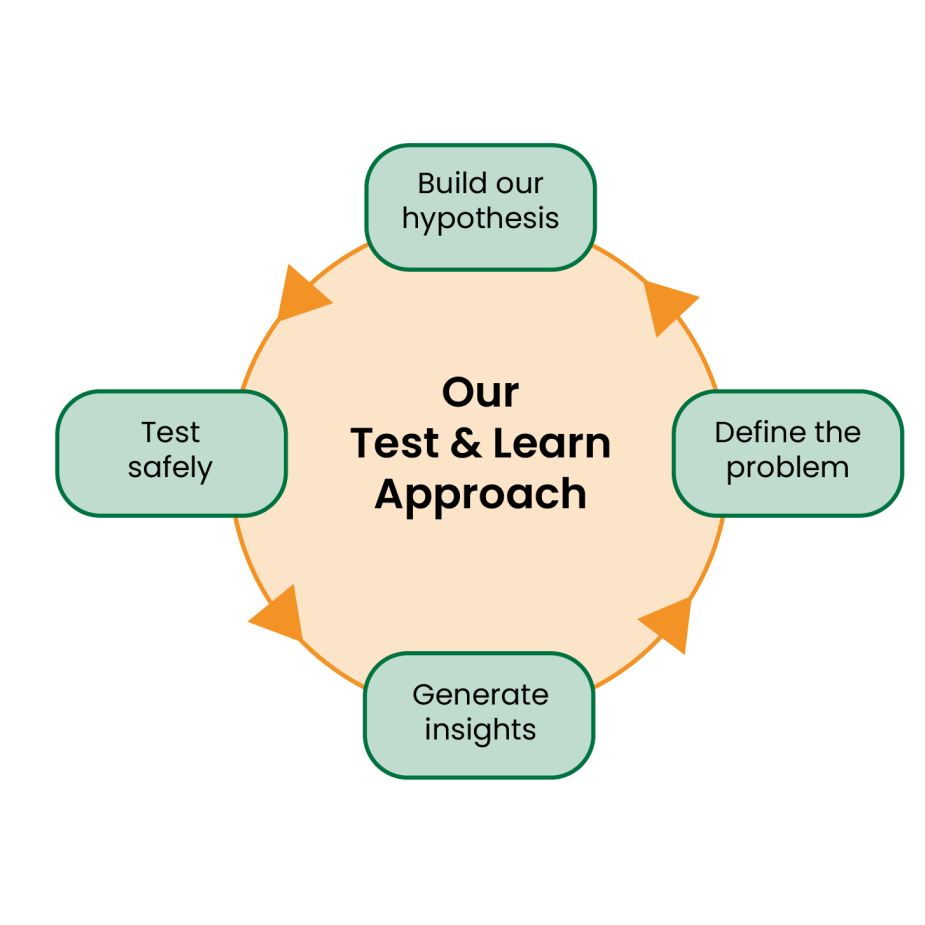
Our approach follows four distinct stages:
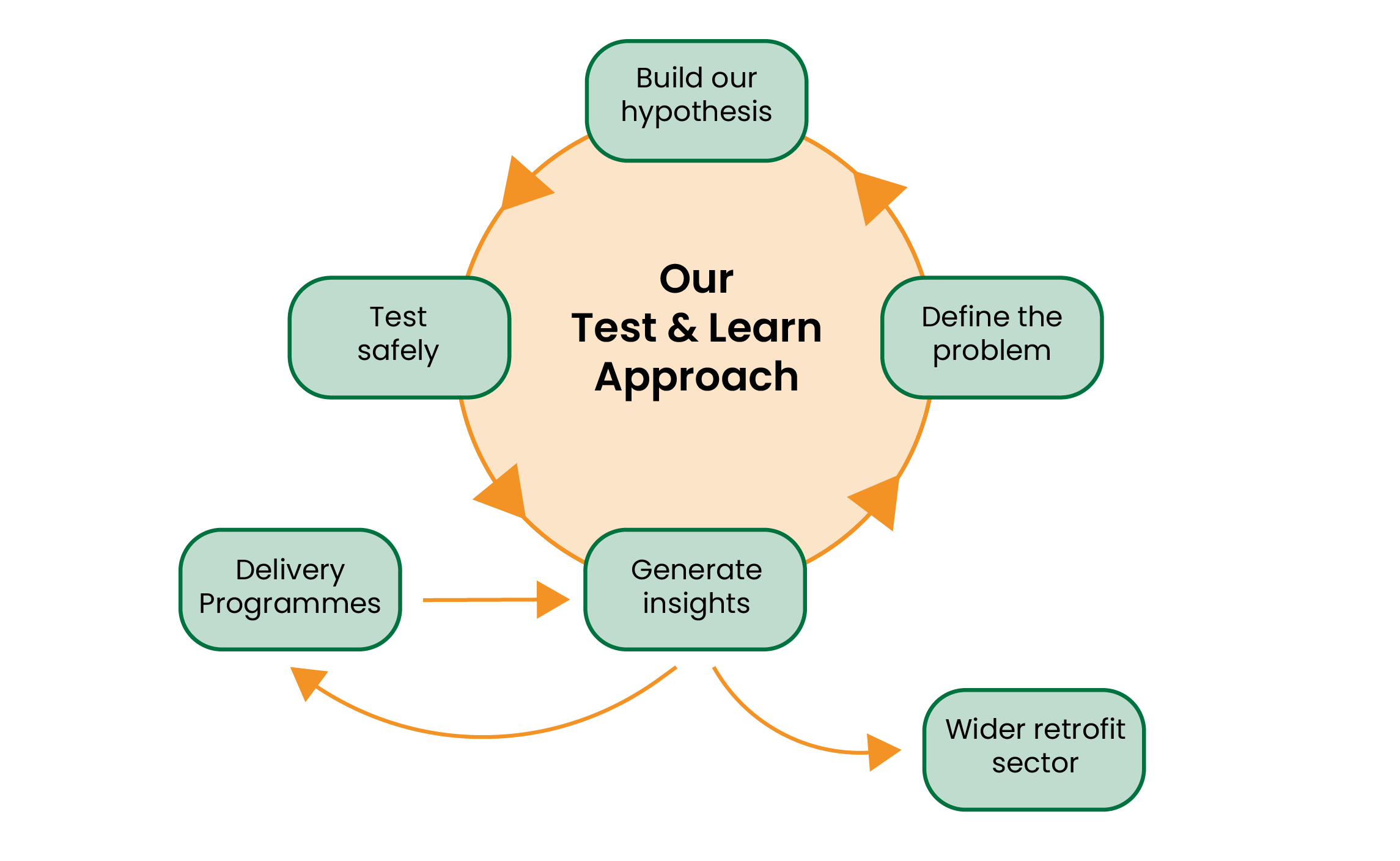
- Develop insights from delivery programmes: We analyze operational data and real-time feedback from local authorities, housing providers, installers, and residents to isolate the biggest barriers to scale.
- Build hypotheses: We identify exactly where regional products, centralized services, or altered workflows could remove those bottlenecks.
- Co-design and test safely: We develop and trial agile solutions with our partners on the ground, ensuring they work in practice, not just in theory.
- Scale what works: Proven approaches are permanently embedded into current delivery programs, shared across the wider sector, and used to inform future national policy.
Instead of 33 boroughs trying to solve the exact same problems independently, London can learn collectively. Every pilot improves the next project.
Our Priorities Ahead
Our Test, Learn, and Scale approach is targeting four leverage points where better system design will unlock the greatest impact:
- Resident Engagement and Trust: Designing frictionless retrofit journeys and clearer communications so residents feel informed, secure, and eager to participate.
- Data and Investment Planning: Standardizing the quality of housing data across the capital so investment decisions become strategic, transparent, and cost-effective.
- Area-Based Planning and Health: Explicitly connecting housing, health data, and place-based planning to prove how more energy efficient homes alleviate pressure on the NHS, targeting investment where it yields the highest social value.
- Skills and Supply Chain Development: Strengthening commissioning capabilities among local authorities while making pipelines of delivery clearer so local businesses have the confidence to invest in training and hiring.
To pull this off, we are bringing together service design, data engineering, product management, and technical retrofit expertise to launch practical pilots. For example, we are currently:
- Launching a resident-centred digital platform to help make the retrofit journey more accessible and understandable for residents.
- Scaling Iot temperature and humidity sensors across homes, so we can evaluate the positive impact of retrofit on tackling damp and mould and layer sensor data with resident feedback to understand impacts on resident health and comfort
- Partnering with trusted local community groups to explore decentralized, community-based resident engagement.
By connecting evidence across disparate programs, co-designing fixes with partners, and scaling what works, Warmer Homes London is actively building the infrastructure, services, and capabilities that the city's future retrofit system demands. We look forward to sharing our data and stories as we grow.